
Polymethylolcarbamide (PMC) as a Advanced Pellet Binder for Aquaculture Feed
December 07, 2025
Polymethylolcarbamide (PMC), also known as urea-formaldehyde prepolymer or methylol urea, is a water-soluble, thermosetting resin derived from the controlled reaction of urea and formaldehyde. In aquaculture feed manufacturing, it serves as a high-performance, multifunctional pellet binder and water stability enhancer. Unlike conventional binders, PMC offers unique chemical binding through polymerization during conditioning and drying, creating a durable, water-resistant network within the feed matrix.
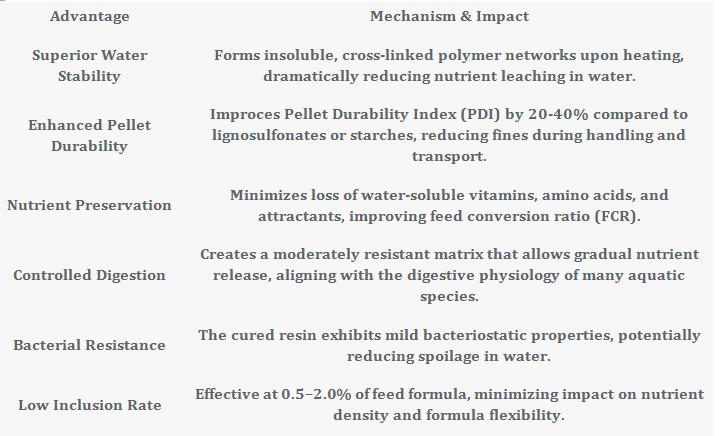
Key Advantages for Aquafeed Application
 Mechanism of Action in Pellet Formation:
Distribution: PMC is uniformly sprayed or blended during conditioning, coating feed particles.
Activation: Heat (70–95°C) and moisture in the conditioner initiate polymerization.
Cross-linking: During pellet mill extrusion and subsequent drying (85–105°C), PMC undergoes further condensation, forming a three-dimensional, water-insoluble resin network that mechanically “glues” particles together.
Curing: Final curing occurs during cooling and storage, achieving maximum strength and water resistance within 24–48 hours.
Polymethylolcarbamide represents a technologically advanced binding solution for modern aquaculture feed production, particularly where extended water stability and pellet integrity are critical. Its chemical binding mechanism offers distinct advantages over physical binders, translating to better economic and environmental efficiency. Successful implementation requires attention to thermal activation during conditioning but rewards with superior pellet quality and optimized nutrient delivery.