
Florfenicol oral solution 10% 20% 30% concentration selection guide
June 27, 2026
Before comparing 10%, 20%, and 30% Florfenicol oral solutions, it is critical to understand their actual mg/mL concentrations, as this determines the final dosing volume in drinking water.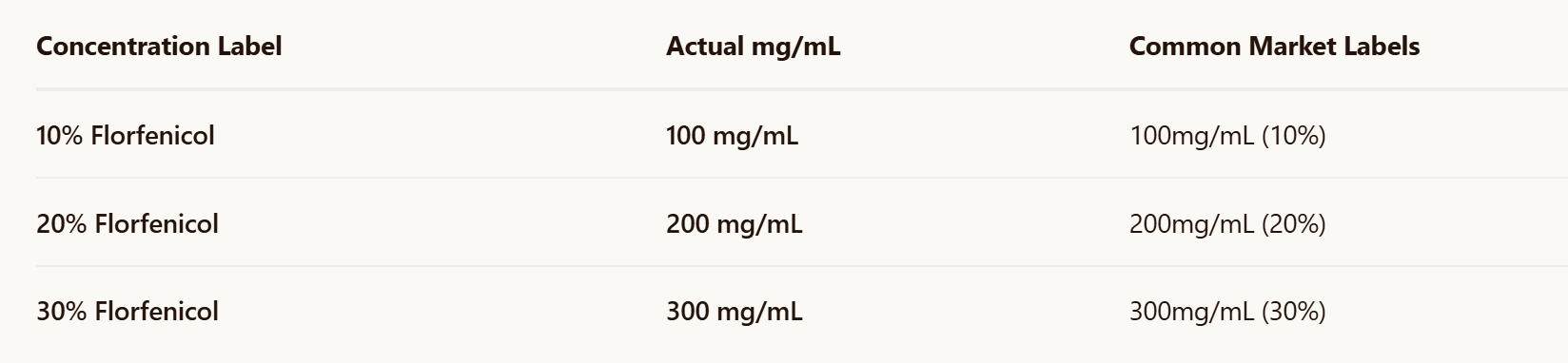 The percentage concentration directly translates to mg/mL: 10% = 100 mg/mL, 20% = 200 mg/mL, and 30% = 300 mg/mL . When selecting a concentration, the primary consideration should be the target animal species, daily water consumption patterns, and logistics cost efficiency.
The percentage concentration directly translates to mg/mL: 10% = 100 mg/mL, 20% = 200 mg/mL, and 30% = 300 mg/mL . When selecting a concentration, the primary consideration should be the target animal species, daily water consumption patterns, and logistics cost efficiency.Species-Specific Dosage Reference:
Poultry Applications
10% Solution: 13.5 mL per gallon of drinking water (equivalent to 30 mg/kg body weight) for 3 days continuously .
20% Solution: 50 mL per 100 liters of drinking water for young broilers (1-2 weeks), increasing to 85 mL per 100 liters for older birds (5-6 weeks), delivering approximately 30 mg/kg body weight .
30% Solution: 100 mL per 1,500 kg body weight (or 1 L diluted in 3,000 L of drinking water) for chickens .
Swine Applications
10% Solution: 9 mL per gallon of drinking water (equivalent to 20 mg/kg body weight) for 5 days .
20% Solution: 1 mL per 10 kg body weight (20 mg/kg body weight) for 3-5 days .
30% Solution: 3 mL per 90 kg body weight (diluted in drinking water, with 30 mL oral solution diluted in 9 liters) .
Cattle Applications
General Note: Dosage must be calculated strictly based on body weight and local regulatory limits. Lower concentrations (10%) may be preferred for larger herds to simplify dosing logistics.
Decision Matrix: Which Concentration to Choose?
✅ Choose 30% (300 mg/mL) When:
Export-Oriented Operations: High-concentration products reduce shipping volume and freight costs per effective unit, making them ideal for international B2B trade.
Limited Storage Space: Farms or distributors with constrained warehouse capacity benefit from the smaller physical footprint.
Large-Scale Farms: High-density operations with automated dosing systems can easily integrate concentrated solutions with precise dilution equipment.
✅ Choose 20% (200 mg/mL) When:
Standard Commercial Farms: The most balanced option for typical poultry and swine operations, offering manageable dilution ratios without excessive handling risks.
Mixed Species Operations: Works effectively across poultry and swine with predictable dosing protocols .
Regional Distribution: Common concentration in many markets, simplifying inventory management for distributors serving diverse customer bases.
✅ Choose 10% (100 mg/mL) When:
Small holder Farms: Lower concentration reduces measurement errors and simplifies manual dosing for farmers with limited technical training.
Safety-First Environments: Reduced risk of accidental overdosing, particularly important for operations with inexperienced staff.
Calves and Young Animals: Lower concentration allows for gentler introduction in sensitive youngstock applications.
Strategic Recommendation for B2B Buyers:
When sourcing Florfenicol oral solutions, consider your customer base's technical capabilities:
Premium Export Markets: Prioritize 30% concentration for cost-efficient international shipping and serve technically advanced farms with automated dosing systems.
Domestic/Regional Markets: Stock 20% as your primary SKU for balanced performance across species and farm types.
Emerging Markets/Smallholders: Include 10% in your portfolio for safety-conscious customers and operations with manual dosing practices.
Complete Portfolio Approach: Offer all three concentrations to capture the full market spectrum—from smallholder farms to industrial export operations.
The concentration you choose should ultimately align with your customers' dosing infrastructure, regulatory environment, and economic priorities. High-volume export operations will favor 30% for logistics savings, while safety-focused smallholders will prefer 10% for ease of use.